Proven, Real-World Strategies From Over 30 Years of Successful Business Purchases Covering Each Step In The Business Buying Process
Over 100,000 copies sold
82% of the people who follow our program and use our free consulting
have bought a business within 6 months
91% of our clients get the seller to finance the deal
UNLIMITED EXPERT ADVICE - We help and mentor you at every step. Whenever you have questions, we will guide and advise you, and there is never any cost to you. If you need advice deciding what type of business is right, or reviewing a listing, help with negotiating, analyzing the financials, compiling a valuation, preparing for and conducting the due diligence, or anything else, our team of experts will assist you every step of the way.
OUR 6 MONTH SUCCESS GUARANTEE - If our program doesn't help you buy a good business at a great price within 6 months, or you are not absolutely thrilled with the materials for any reason, at any time, we will immediately refund your money. No fine print. No conditions. No time limit. Our guarantee never expires. We've been helping people buy good businesses for over 30 years. We're not going anywhere. When you have a program that works as well as ours, there's never any fear of giving people an iron-clad zero risk guarantee.
Hi, I’m Richard Parker and if you’ve ever dreamed of buying a business that brings you financial freedom and security, I will personally guide and advise you every step of the way.
Over the past 34 years, I have been involved in all aspects of the business buying process as a buyer, seller, intermediary, and investor. I have purchased 14 businesses including one co-investment with deal sizes ranging from $50,000 to over $200 million.
I was the Managing Director and partner of P-Squared with Ray Dalio and the Dalio family office, where I was hired to mentor one of Ray’s sons in the art of buying businesses.
Our program - How To Buy A Good Business At A Great Price© is the most widely used strategy guide and reference resource for buying a business. It has helped tens of thousands of people acquire businesses resulting in over $2 billion in transactions. The reason why it has sold over 100,000 copies and has helped countless entrepreneurs like you achieve financial success is because it works!
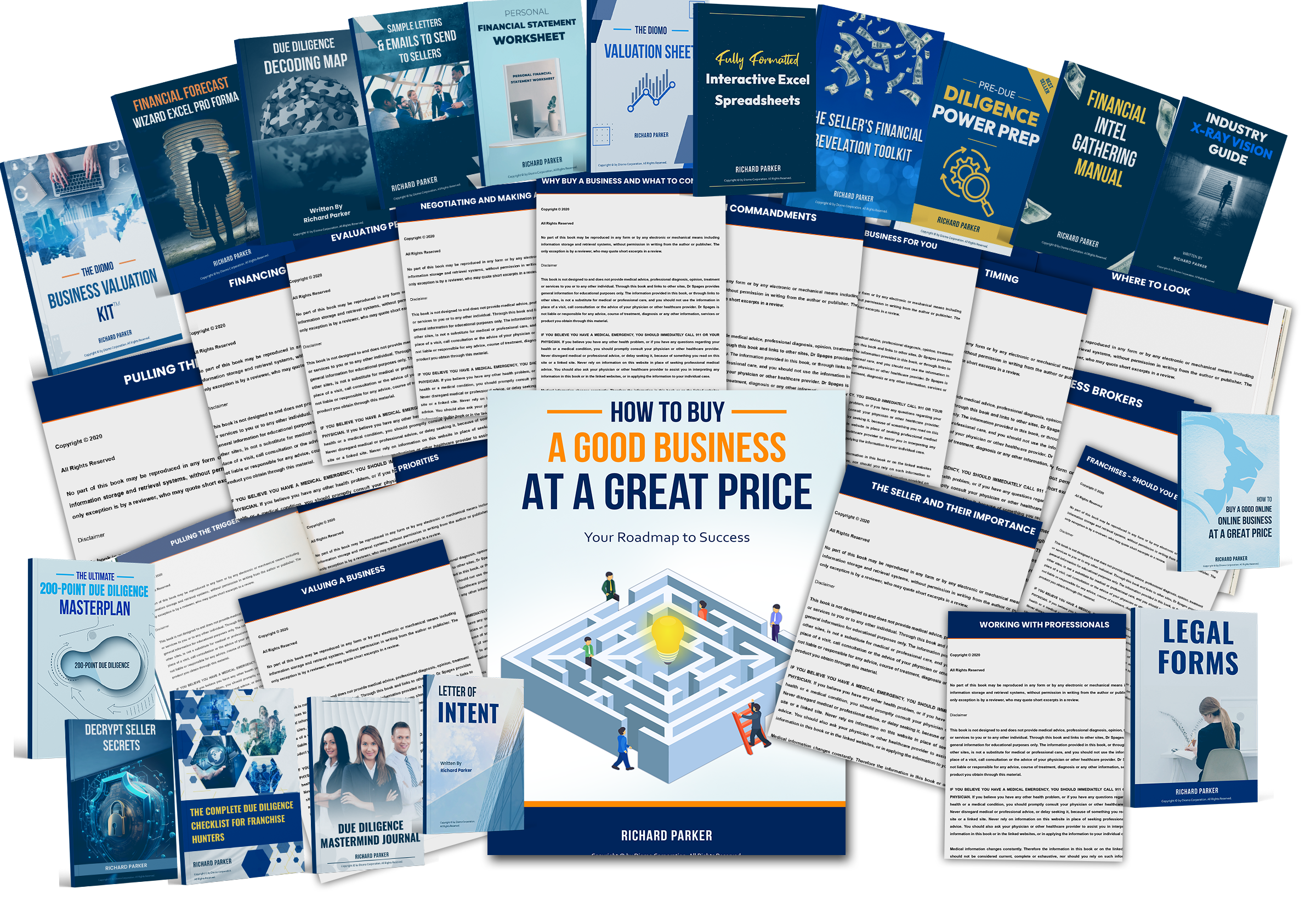
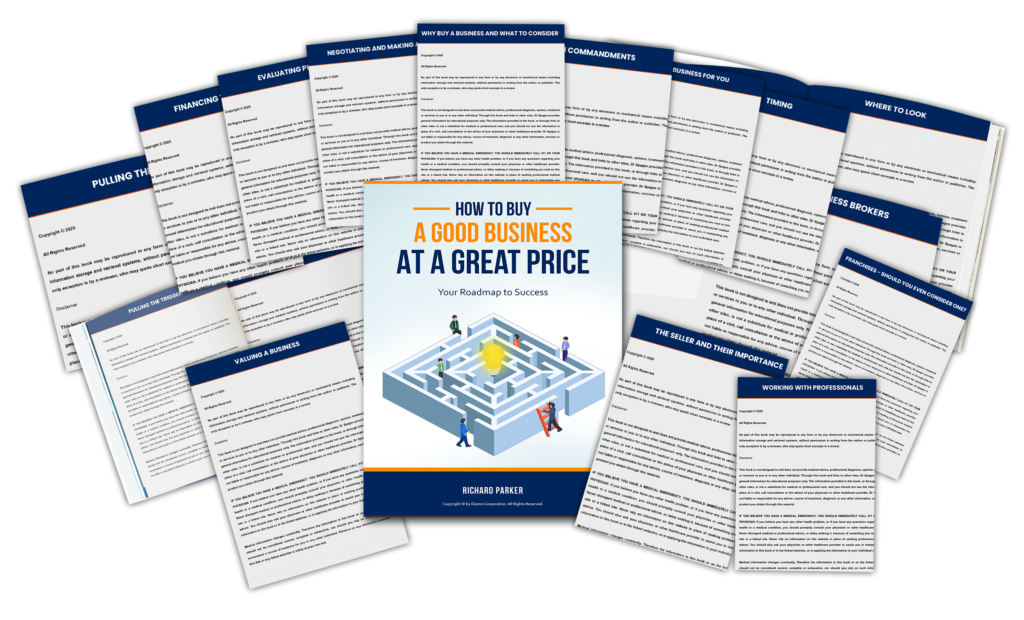
The material contains over 500 pages of expert strategies covering each of the 23 steps in the business buying process. You will learn practical, proven, and real-world knowledge that explains everything you must know, what to do, and precisely how to do it for every step and major decision you will face.
According to industry statistics, over 90% of people who start looking to buy a business never complete a purchase. Even worse, the average person spends 18 months searching for businesses for sale and they never buy one. It’s a monumental waste of time!
The problem lies in underestimating the complexity of buying a good business at a great price. This leaves many first-time buyers feeling overwhelmed, ill-equipped, and unprepared for the major decisions they encounter. Buying a business is not difficult; but it is complex, and you must follow a specific set of steps and know exactly what to do at every stage. You cannot afford to make any mistakes because the costs can be horrific.
Compare that to our program – 82% of the people who follow our program and use our ongoing free support buy a good business within six months.
How To Buy A Good Business At A Great Price© along with our unlimited and free consulting support will help you every step of the way.
With the right information and the right advice, you’ll always make the right decisions.
While our material will provide you with the knowledge, you’ll need to become a properly prepared, well-informed and savvy business buyer, you may in fact encounter some real-world situations where you’ll want additional expert and unbiased advice.
Starting today, you will have unlimited access to a group of business buying specialists.
Whenever you need help, just contact us, outline the situation, and let us know if you’d like an email response or a phone call. We will review the situation and provide you with our input and assessment within one business day.
No matter what circumstance you come across, with our step-by-step strategy guide, and ongoing personal support, you will make the right decision!
Best of all, there is no additional cost for this service, and you can use it as often as you wish!
Don bought our course, invested $30,000 to buy a business then several others, and sold them for $6 million
Iggy and his partner followed our program and bought a small business, then many others and grew them to
$200 million in revenue and sold out for $100 million
"Your book is fabulous and very informative. I’ve learned a tremendous amount of information and it is helping me with the whole business buying process. To get this amount of information would take years of talking to many different people and then filtering out information and by that time I would be ready to retire. Thank-you for the program.” "Dear Mr. Parker, I finished your course today and I must tell you I think it was worth every penny! I did own a business for 15 years but I learned more from your course than I did in all that time. I am currently negotiating with a hair salon and feel much more equipped to handle it all since I have the course to refer back to. I am not in the habit of writing to every person who sells a product to me but you did such a fine job that I felt I should let you know how I feel. Once again, thank you – the job you did was exceptional.” “I have completed the purchase of another pest control company – Superior Termite and Pest Control to go along with my other company Alexandria Pest Services. Your information was very helpful and I would recommend it to everyone. Thanks again.” “I want to take this opportunity to congratulate you as well as your staff at Diomo Corp. It’s a real pleasure to do business with honest professional people/company such as yourselves.” “How To Buy A Good Business At A Great Price©️ is the most complete program on buying a business that I have ever read.” “Investing in your course has been fantastic. It is extremely well organized, fast paced, and gets to the bottom line! Your status/encouragement e-mails are also great motivators. Thank you for your guidance with my questions.” “I read ‘How to buy a good business at a great price©️‘ and it changed my life. That started me and my partners on a road to buying businesses, and since then we have used its principals to buy 10 businesses with 300+ employees and $200M + in annual sales and learned a lot of crazy lessons along the way. Thanks for inspiring us! A couple weeks ago I called up Richard to chat about our journey and to learn about his. It was one of the most enjoyable conversations I’ve ever had and reinforced how much I respect Richard as a business leader. Pick up the program for yourself. It might just change your life too!” "I would like to take the time to write you a letter to thank you for your course “How to buy a Good Business at a Great Price©️” and what it has done for me. I worked in financial services for over 10 years and was able to save and invest some money. I always wanted to own my own business (traditional) and was seeking knowledge when I happened upon your course. I ordered it and closed on our first business six months later. It was a retail mall based bulk candy store that wasn’t making any money for the absentee owner after two years of operations. After a thorough review of the business using your techniques I was convinced that we could make a profit and add value. By the year-end we had made all of our initial investment back and had a very nice profit – I was hooked! To make a long story short last July I was able to purchase my biggest competitor and increased our revenue by 250% and our profits by a whopping 290% and yes I now know how to buy a good business at a great price©️….thanks to your course! Today my family and I are living the lifestyle that as a child I could not even imagine! Again thank you for your time, knowledge and inspiration. All the best.” “I’ve worked through two-thirds of your course and I have to say that this is the most comprehensive business buying course in existence! I’m thoroughly impressed by the content (and context) and would gladly recommend it to any and all potential business buyers.” “I’ve found your book to be of tremendous value. You have really performed a service in writing in your straightforward manner. Thank you for sharing your wealth of knowledge!” “I was going through old e-mail and found some of our correspondence. I just wanted to say THANK YOU once again. I can attest that you helped me through what could have been a complex transaction. Since purchasing the business we have tripled our volume and our profit has grown 50% annually. I highly recommend you and your service. Thanks again.” “Your course is superb. My only regret is that I had not run across this resource earlier, prior to my last business.” “I finally bought my first business (My life long dream). It is a Breakfast & Lunch Cafe in Downtown Miami. The ride has been incredible, lots of learning on the go. Your book was awesome. It really gave me an excellent base of knowledge to work with.” “I am writing to let you know how much I got from your program. I bought Superior Windows & Doors and felt it was a diamond in the rough. We have done better every month than the prior owner since we took over. I highly recommend your material to people that even hint that they would like to be business owners. We would not be here without your guidance. Thank you.” “I want to let you know that I’m a “10 Percenter”. I bought your program in mid September last year and closed on my business in January. Your program was very insightful and definitely provided the guidance for me to get this far. I just wanted to tell you so you can add to your statistics. Thanks!” "I’m closing a business purchase next month and I wanted to let you know that your manual was a very useful tool in making that decision. I’ve been an entrepreneur all my life so this wasn’t my first business purchase. If this manual been available before, I could have saved a ton of money and avoided some big mistakes on my other purchases. "Thank you so much for a wonderful “how to” guide. I found it to be invaluable. I’m under contract and in the due diligence phase to purchase a pet products company. The lists for due diligence are GREAT! Reading this guide was time & money well spent. My business broker, accountant and lawyer were all impressed with my preparedness and well thought out questions.” “Well, I finally closed on the business. I would not have been able to go through the entire process without your course and your personal guidance. There were many challenges along the way. I just kept reading and rereading your course throughout. Thank you for all of your help.” “Your book is fabulous and very informative. I’ve learned a tremendous amount of information and it is helping me with the whole business buying process. To get this amount of information would take years of talking to many different people and then filtering out information and by that time I would be ready to retire. Thank-you for the program.” “I can’t thank you enough for your course and your counseling. I purchased an automotive repair business and am doing pretty well with it starting into my second month. The course is right on and taught me a wealth of information about buying a business. Thanks again for sharing your information and helping people like me.” “I’ve just completed the purchase of an established business with a 30-year history, now retiring its second owner. Your guide was perfect in helping me select this business, especially in assessing its value. Thanks again for your personal attention to my purchase and pursuits.” Everything we tell you about our material is backed up with an ironclad guarantee. If you are not thrilled with our materials for any reason, we don’t want you to pay for them. Follow our techniques, use our consulting, and if we don’t exceed your expectations, let us know anytime for an immediate refund. No questions asked. No time limits.
Arthur Pottorff
Palm Bay, Florida

Christine Hanson
Rio Nido, CA
Richard A. Diggs
Alexandria, VA
Manuel Cheskes
Houston, TX
Peter Shea
Chairman and CEO - Entrepreneur Magazine
Steven Krug
Signal Mountain, TN
Iggy Domagalski
Calgary, AB
Don Wilson
Tulsa, OK
Brian L. Shawver
Bend, OR
Phyllis H. Detwiler
Middletown, NJ
Odette D”Aniello
Celebrity Cake Studio - Tacoma, WA
Jeff Boaz
San Diego, CA
Ozzie Clausell
Miami, FL
Roy Cooper
Ashland , OR
Fred Graff
Louisville, KY
Terry Huston
Tampa, Florida
Cindy Ozmun
Warwick, RI
Robert Rock, Jr.
Webster, NY
Zane and Sarah Bary
South Island, New Zealand
Bruce Dunker
Tyrone , NM
Gil Takemori
San Jose, CA
OUR 100% NO QUESTIONS ASKED GUARANTEE AND REFUND POLICY
HERE'S EVERYTHING YOU GET WHEN YOU SIGN UP TODAY!